Skip to content Skip to left sidebar Skip to right sidebar Skip to footer

Education

From Labs to Startups: How Indian Universities Are Bridging Theory with Practical Skills & Adaptability

Education is no longer just about degrees—it’s about readiness.

Across India, a quiet revolution is transforming campuses from traditional lecture halls into innovation ecosystems where theory meets practice, research fuels entrepreneurship, and students graduate not just with certificates, but with real-world adaptability.

From IITs and NITs to state universities and private institutions, Indian higher education is embracing a powerful new mandate: prepare students not just for jobs, but for impact.


🔑 The Shift: Why Practical Skills Matter Now More Than Ever

The global economy is evolving at breakneck speed. Automation, AI, climate tech, and digital transformation are reshaping industries—and the skills required to thrive in them.

Traditional education models, focused heavily on rote learning and theoretical exams, are struggling to keep pace.

That’s why forward-thinking Indian universities are now prioritizing: ✅ Hands-on learning through labs, projects, and industry collaborations
Entrepreneurial mindset via incubation centers and startup mentorship
Adaptability & critical thinking through interdisciplinary curricula
Industry-ready competencies via internships, certifications, and capstone projects

💡 The Goal: Produce graduates who can solve problems, not just pass exams.


🌟 How Universities Are Making It Happen: 5 Key Strategies

1️⃣ Integrated Incubation & Innovation Hubs

Leading institutions are embedding startup support directly into campus life:

  • IIT Madras: Home to over 300+ startups via its Incubation Cell
  • BITS Pilani: Technology Business Incubator nurturing deep-tech ventures
  • IIIT Hyderabad: T-Hub partnerships connecting students to Hyderabad’s startup ecosystem
  • University of Hyderabad: Social innovation labs driving community-impact ventures

These hubs offer: 🔹 Seed funding access
🔹 Mentorship from industry veterans
🔹 Prototyping labs and co-working spaces
🔹 IP guidance and legal support

2️⃣ Curriculum Redesign: Learning by Doing

Under the **National Education Policy **(NEP 2020), universities are overhauling syllabi to include:

  • Credit-based internships: Mandatory industry exposure for degree completion
  • Project-based learning: Real client briefs replacing hypothetical assignments
  • Micro-credentials: Stackable certifications in AI, data science, design thinking, etc.
  • Interdisciplinary electives: Engineering students taking business courses; humanities students learning coding

🎯 Outcome: Graduates who can collaborate across domains and adapt to evolving role requirements.

3️⃣ Industry-Academia Partnerships That Deliver

Universities are moving beyond MoUs to co-created value:

  • Live industry projects: Companies sponsor student teams to solve actual business challenges
  • Adjunct faculty from industry: Practitioners teaching cutting-edge tools and workflows
  • Joint R&D labs: Collaborative research with commercialization pathways
  • Placement-plus programs: Training aligned with specific employer skill maps

Example: VIT Vellore’s “Grand Challenge” program partners with TCS, Infosys, and startups to give students end-to-end product development experience.

4️⃣ Skill Labs & Makerspaces: Where Ideas Become Prototypes

Campuses are investing in physical infrastructure that enables experimentation:

  • AI/ML labs with GPU clusters for student research
  • IoT & robotics workshops with 3D printers, sensors, and microcontrollers
  • Design thinking studios for user-centered problem solving
  • Media labs for content creation, UX/UI, and digital storytelling

These spaces democratize innovation—any student, regardless of branch, can prototype an idea.

5️⃣ Soft Skills & Adaptability: The Hidden Curriculum

Technical prowess alone isn’t enough. Universities are now intentionally cultivating:

  • Communication & storytelling: Pitching ideas, writing proposals, presenting research
  • Emotional intelligence: Team dynamics, conflict resolution, leadership
  • Resilience & growth mindset: Learning from failure, iterating quickly
  • Ethical reasoning: Responsible innovation, sustainability, social impact

🌱 Why it matters: In a volatile job market, adaptability is the ultimate career insurance.


📊 Impact by the Numbers

MetricTrend
University Incubators1,000+ across India (up from ~200 in 2015)
Student Startups Funded₹500+ Cr via government & private schemes (2024–25)
Industry-Linked Courses70% of engineering programs now include mandatory internships
NEP Implementation85% of central universities have begun curriculum restructuring
Placement DiversityRising hires in product, consulting, and founder roles—not just IT services

🎯 Success Stories: Students Who Leaped from Lab to Launch

🔹 Abyom SpaceTech (BITS Pilani Hyderabad): Student team building reusable rocket engines
🔹 Apollyon Dynamics (BITS Hyderabad): 21-year-old founders developing defense UAVs for Indian Army
🔹 Niramai (IIT Madras spin-off): AI-powered breast cancer screening startup founded by researchers
🔹 AgNext (Punjab Agricultural University): Agri-tech startup using spectroscopy for food quality

These aren’t exceptions—they’re emerging patterns.


🚧 Challenges on the Path Forward

Progress isn’t uniform. Key hurdles remain: ⚠️ Faculty readiness: Not all educators are trained in experiential pedagogy
⚠️ Infrastructure gaps: Tier-2/3 colleges lack labs, funding, and industry access
⚠️ Assessment reform: Evaluating creativity and collaboration is harder than grading exams
⚠️ Equity concerns: Ensuring rural and first-generation students benefit equally

Addressing these requires sustained investment, policy support, and cultural change.


💡 What Students & Parents Can Do Today

Choose institutions with active incubation cells and industry partnerships
Seek project-based courses and credit-bearing internships
Build a T-shaped profile: Deep expertise + broad adaptability
Embrace failure as learning: Join hackathons, pitch competitions, prototype challenges
Network intentionally: Connect with alumni, mentors, and industry guests on campus


🌍 The Bigger Vision: Education for an Uncertain Future

The ultimate goal isn’t just employability—it’s empowerment.

By integrating practical skills and adaptability into higher education, Indian universities are preparing a generation that can: 🔹 Navigate ambiguity with confidence
🔹 Create value in any context
🔹 Lead with purpose in a complex world

🚀 “We’re not just teaching students to find jobs. We’re preparing them to shape the future.”


✨ Join the Movement

Whether you’re a student, educator, parent, or industry leader, you have a role to play: 🔹 Students: Seek out experiential opportunities—don’t wait for them to come to you
🔹 Educators: Champion pedagogy that values doing over memorizing
🔹 Employers: Partner with universities to co-create talent pipelines
🔹 Policymakers: Fund infrastructure and incentives for skill-integrated education

The future of work is being built in today’s classrooms. Let’s ensure it’s built on skills, adaptability, and impact.

ISB Hyderabad Celebrates Graduation of 478 Future Leaders

A Milestone Moment at India’s Premier B-School

Hyderabad, March 2026 — The sprawling campus of the Indian School of Business (ISB) Hyderabad buzzed with excitement, pride, and anticipation as 478 students from the 2024-25 cohorts crossed the threshold into their next chapter. The graduation ceremony marked the culmination of intense learning, transformative experiences, and the forging of lifelong connections.

The Graduating Cohorts

This year’s graduating class comprised diverse programmes tailored for different stages of professional leadership:

  • PGP MAX Co2025 — Advanced management programme for senior executives
  • PGP PRO Co2025 — Part-time programme for working professionals
  • PGP MFAB Co2025 — Programme for family business management
  • AMPBA Winter Co2024 & Summer Co2025 — Advanced management programme for business administration

Together, these 478 graduates represent the future of Indian business leadership—equipped with cutting-edge knowledge, global perspectives, and the ISB stamp of excellence.

A Grand Procession

The ceremony opened with a dignified academic procession led by Prof. Madan Pillutla, Dean of ISB, alongside Jayadev Galla, Co-Founder and Chairman of Amara Raja Group, who graced the occasion as chief guest. Senior faculty members joined the procession, symbolizing the passing of wisdom from mentors to the next generation of leaders.

The Dean’s Message: Technology Meets Responsibility

In his address to the graduating class, Prof. Madan Pillutla delivered a powerful message that resonated beyond the auditorium. While acknowledging technology’s immense potential to solve global challenges, he emphasized a crucial caveat: its true impact relies on responsible leadership.

In an era where AI and digital transformation dominate boardroom conversations, Prof. Pillutla’s words served as a timely reminder that innovation without integrity is hollow. The graduates weren’t just leaving with business acumen—they were carrying a mandate to lead with purpose and responsibility.

Celebrating Excellence

The ceremony wasn’t just about conferring degrees; it was about recognizing those who pushed boundaries:

Academic Honors:

  • Scholar of Excellence Awards — Presented to outstanding students from each programme
  • Dean’s List — Recognizing consistent academic brilliance across cohorts

Behind the Scenes: Faculty members and academic associates received special recognition for their pivotal role in shaping these 478 journeys. After all, great leaders are forged by great mentors.

The Amara Raja Connection

The presence of Jayadev Galla as chief guest added significant weight to the proceedings. As Co-Founder and Chairman of the Amara Raja Group, one of India’s most respected business conglomerates, Galla embodies the entrepreneurial spirit and ethical leadership that ISB seeks to instill in its students.

His journey—from building a battery manufacturing giant to diversifying into infrastructure and energy—offered graduates a real-world blueprint for sustainable business growth.

What Makes This Graduation Special

ISB Hyderabad isn’t just a business school; it’s a leadership factory. Since its inception, the institution has consistently ranked among the top business schools globally, attracting the brightest minds from India and abroad.

These 478 graduates join an alumni network of over 15,000+ leaders across 50+ countries—a community that includes CEOs, entrepreneurs, policymakers, and change-makers. The ISB badge opens doors, but more importantly, it creates a responsibility to lead with impact.

Looking Ahead

As these graduates step into the world, they carry more than just certificates. They carry:

  • Knowledge forged through rigorous case studies and experiential learning
  • Networks built across diverse industries and geographies
  • Values instilled through ISB’s commitment to responsible leadership
  • Confidence to tackle complex business challenges in an uncertain world

The ceremony may have lasted a few hours, but its impact will ripple through boardrooms, startups, and communities for decades to come.

Congratulations, Class of 2024-25!

To the 478 new graduates: Your journey at ISB has ended, but your journey as leaders has just begun. The world awaits your contributions. Lead wisely, act responsibly, and never stop learning.

Here’s to the next chapter! 🎓

HYDRAA Intensifies Fire Safety Inspections Across Hyderabad, Warns of Strict Action

Hyderabad:
The Hyderabad Disaster Response and Asset Protection Agency (HYDRAA) has stepped up enforcement of fire safety norms across the city, warning of strict action against establishments violating regulations.

HYDRAA Commissioner A.V. Ranganath has ordered intensified inspections across commercial zones following recent fire incidents. He directed officials to ensure strict compliance with fire safety regulations in both commercial establishments and residential areas.

A coordination meeting was held on Wednesday with officials from the Greater Hyderabad Municipal Corporation (GHMC), the Fire Services Department, and the Electricity Department to streamline enforcement measures.

Inspection teams have been instructed to conduct checks at business complexes, furniture showrooms, textile shops, and other commercial premises. Establishments found violating mandatory fire safety norms will be sealed, the commissioner said.

Power Disconnection for Non-Compliance

Ranganath also ordered the immediate disconnection of electricity supply to non-compliant establishments. Officials were directed to paste notices declaring such premises as lacking mandatory fire safety measures. Inspections will be conducted across all parts of the city without exception.

Public Urged to Report Fire Hazards

The commissioner appealed to citizens to report potential fire hazards to the HYDRAA control room at 9000113667. Residents were asked to share the exact location along with photographs or videos of unsafe conditions. He assured that the identity of informants would be kept confidential.

HYDRAA emphasized that public cooperation is crucial to preventing fire accidents and ensuring public safety across Hyderabad.

Hyderabad Police ‘Arrive Alive’ Road Safety Program Draws Over 600 Participants

The Hyderabad City Police on Wednesday, January 28, organised ‘Arrive Alive’, a road safety awareness programme, at the APJ Abdul Kalam Auditorium in Ibrahim Bagh. The event was held in collaboration with Vasavi Engineering College and was attended by over 600 students and faculty members.

Addressing the gathering, Joint Commissioner of Police Joel Davis said the Arrive Alive movement was launched by Telangana Director General of Police B. Shivadhar Reddy with the aim of ensuring that road safety awareness reaches every household and institution across the State.

Highlighting the alarming rise in road accidents, Davis said nearly 8,000 people lost their lives in road accidents in Telangana last year, adding that 70–80 per cent of these fatalities were preventable had basic safety precautions been followed. He also underlined the severe socio-economic impact road accidents have on families.

Speaking about the Good Samaritan Act, Davis explained that bystanders who assist accident victims are not required to disclose personal details or phone numbers and will not be compelled by police to act as witnesses. He added that private hospitals are legally mandated to provide immediate treatment during the ‘golden hour’, and noted that the government is exploring reward mechanisms through the Transport Department for individuals who help save lives.

Deputy Commissioner of Police (Traffic) Rahul Hegde said roads are shared public spaces and traffic rules are designed to ensure safety and equal access for all citizens. He urged students to behave responsibly on roads and to act as ambassadors of road safety in society.

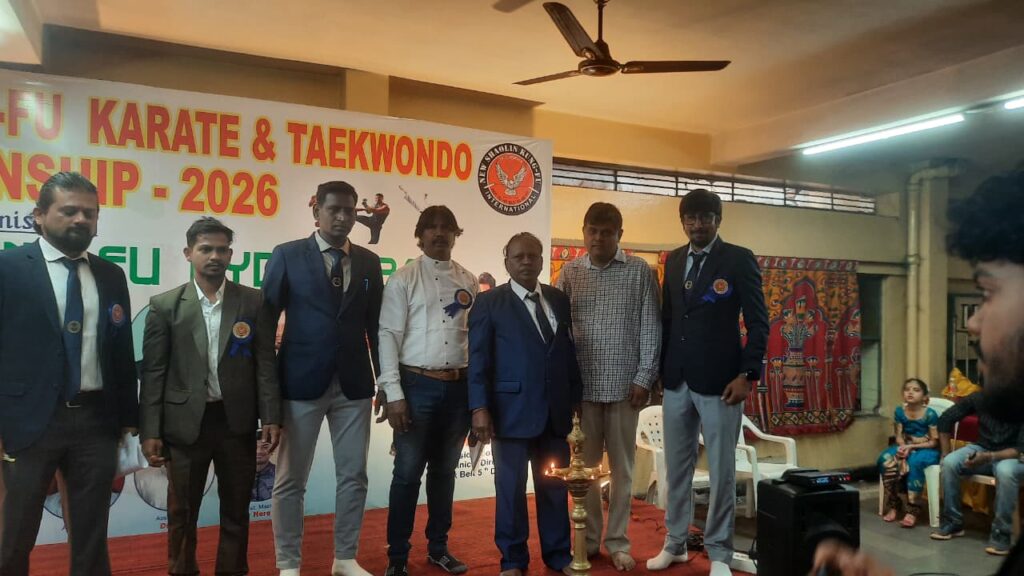
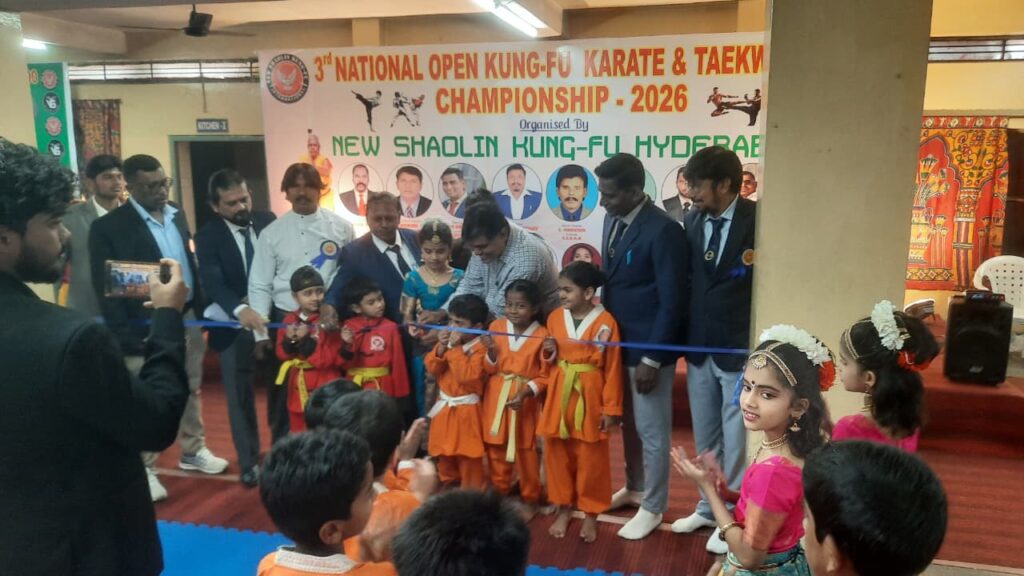
National Open Kung-Fu, Karate & Taekwondo Championship – 2026

Successfully Held at Marri Krishna Hall, Tarnaka, Hyderabad

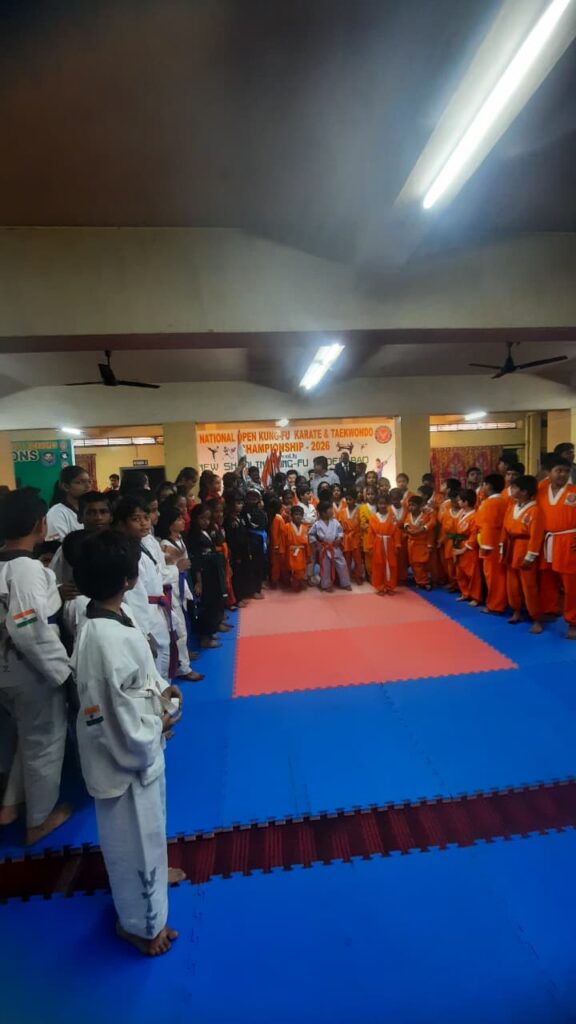
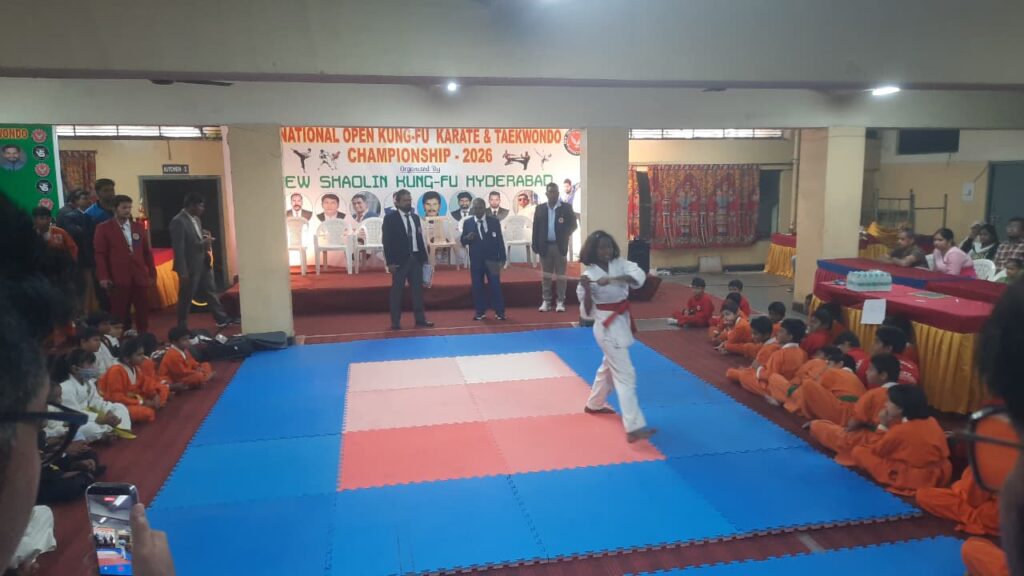
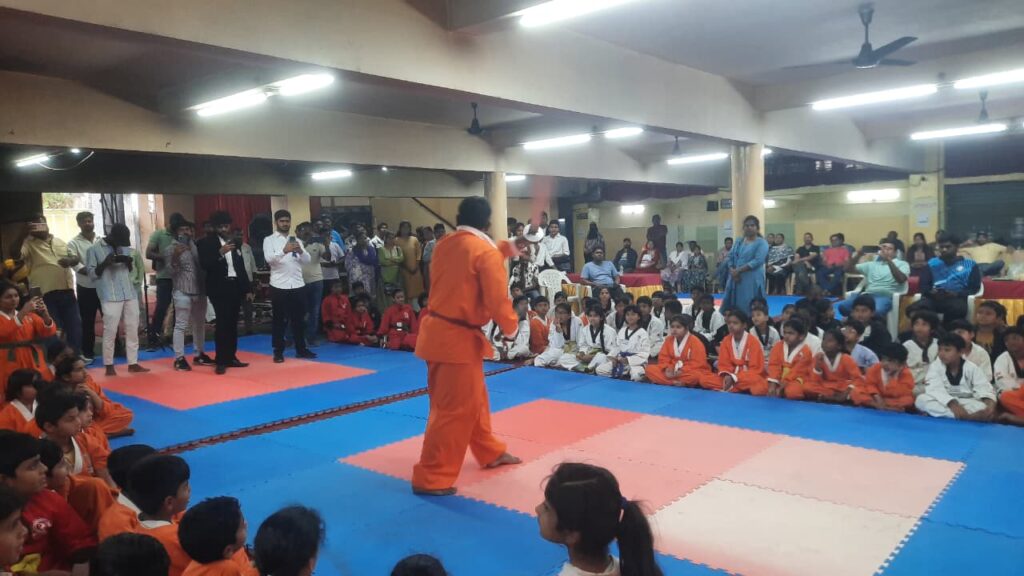
The National Open Kung-Fu, Karate & Taekwondo Championship – 2026, organized by New Shaolin Kung-Fu Hyderabad, was successfully conducted at Marri Krishna Hall, Tarnaka, Hyderabad with great enthusiasm and discipline.

The championship witnessed active participation from martial artists representing various states, academies, and associations across the country. Competitions were held in Kung-Fu, Karate, and Taekwondo across multiple age and weight categories, showcasing high standards of skill, strength, and sportsmanship.

The event was graced by the presence of senior martial arts masters, referees, officials, and distinguished guests, whose encouragement motivated the athletes to perform at their best. The well-organized matches, fair officiating, and smooth event management were widely appreciated by participants and spectators.

At the conclusion of the championship, medals and certificates were awarded to the winners and participants, recognizing their dedication and achievements. The event served as a strong platform to promote martial arts culture, discipline, and unity at the national level.

The National Open Kung-Fu, Karate & Taekwondo Championship – 2026 concluded on a successful note, and New Shaolin Kung-Fu Hyderabad extends heartfelt congratulations to all participants, coaches, officials, and organizers for making the event a grand success.

Conference on Air Quality Index to Be Held in Hyderabad on January 29-2026

Hyderabad:
The State Planning Department will organise a conference on Air Quality Index (AQI) and air quality management at the Dr. MCRHRD Institute of Telangana in Hyderabad on Thursday, January 29, with technical support from the Telangana State Pollution Control Board.

According to an official press note, the conference aims to bring together experts, stakeholder departments, non-governmental organisations, universities and civil society groups to discuss effective strategies for improving air quality across the State. Specialists in the field will share best practices for regulating various sources of air pollution and strengthening coordinated action among stakeholders.

The session will be chaired by Deputy Chief Minister Mallu Bhatti Vikramarka, along with other Ministers, senior officials and subject experts.

Key topics to be discussed during the technical sessions include the adoption of best available techniques, increased use of cleaner fuels to minimise emissions, and strategies for reducing road transport emissions towards net-zero targets. The discussions are expected to focus on practical solutions and policy-level interventions for sustainable air quality management.

The conference is part of the State government’s ongoing efforts to address environmental challenges and promote cleaner, healthier urban environments in Telangana.

Hyderabad’s Iconic ‘Fish Building’ Swims Into Global Spotlight as One of the World’s Strangest Structures

Hyderabad: January 26, 2026
In a city celebrated for its cutting-edge IT corridors and centuries-old heritage monuments, an unconventional government building has quietly captured international attention. The headquarters of the National Fisheries Development Board (NFDB) in Hyderabad has been named among the world’s strangest-looking buildings, placing the city on global lists of architectural curiosities.

Constructed in 2012, the four-storey structure is designed entirely in the shape of a giant fish, complete with a metallic exterior, sweeping fins and two large circular windows that resemble eyes when viewed from a distance. The building is a striking example of mimicry architecture, a design philosophy in which a structure’s form directly reflects its function. In this case, a fisheries body operates from a building that quite literally looks like a fish.

The visual impact of the structure becomes even more dramatic after sunset. Bathed in blue spotlights, the building appears like a massive fish gliding through water, creating a surreal illusion that stands out sharply against Hyderabad’s urban skyline.

While the bold design initially received mixed reactions during its construction, the Fish Building has since evolved into a recognisable city landmark. Today, it attracts tourists and architecture enthusiasts as much as government officials, with passersby frequently stopping to photograph the unusual façade and admire its departure from conventional government office design.

On the global stage, the Hyderabad landmark now finds itself in the company of other famously eccentric buildings, including the basket-shaped former headquarters of an office supplies company in the United States, Poland’s twisted Crooked House, and Florida’s guitar-shaped hotel. Its inclusion among these structures has offered India a rare moment of international recognition for experimental public architecture.

Beyond its visual novelty, the Fish Building symbolises a broader shift in how civic spaces are imagined. It serves as a reminder that government buildings need not be anonymous concrete blocks, but can instead be creative, expressive and capable of capturing public imagination—even in the heart of a fast-growing modern city.

From Hyderabad to the USA: A Father’s Unfulfilled Dream and a Son’s Historic Cricketing Rise

When Vikram Reddy Sudini left Hyderabad for the United States in 1999, he wasn’t just moving countries — he was leaving behind a dream that had defined his youth. A passionate cricketer who had grown up playing the game with dedication and ambition, Vikram had once hoped to make a name for himself on the cricket field. However, like countless others, life took a different turn.

Armed with an engineering degree and aspirations of building a stable future, Vikram relocated to the U.S. to work as a software engineer. The move brought opportunity, security, and success — but it also meant stepping away from competitive cricket. The bat and ball were replaced by keyboards and code, yet the love for the game never faded.

A Dream That Refused to Die

Although Vikram’s personal cricketing journey ended prematurely, the dream itself remained alive. When his son Nitish Reddy Sudini was born, Vikram saw not pressure, but possibility. Rather than forcing ambition, he gently introduced Nitish to the game that had shaped his own childhood.

What began as playful tennis-ball cricket soon turned into structured practice. Vikram noticed his son’s natural timing, discipline, and hunger to improve. Living in the U.S. — a country where cricket still fights for mainstream attention — posed challenges. Facilities were limited, competition was sparse, and opportunities were far fewer compared to cricket-mad nations like India.

Yet, Vikram refused to let geography become an excuse.

Hyderabad: The Classroom That Built a Cricketer

Every year, Vikram brought Nitish back to Hyderabad, ensuring his son trained in proper Indian cricketing conditions. From turf wickets to quality coaching, Nitish experienced the grind of competitive cricket early on. He practised against spin bowlers, learned footwork on slower pitches, and developed the temperament needed for long innings.

These trips were more than just training stints — they were lessons in discipline, humility, and resilience. While other children enjoyed holidays, Nitish spent countless hours in the nets, absorbing advice from coaches and guidance from a father who understood both the joy and heartbreak of the sport.

Rising Through the Ranks in the USA

Back in the U.S., Nitish continued playing league cricket, gradually gaining attention for his consistency and maturity beyond his years. His technique — clearly influenced by Indian conditions — stood out in American cricket circles. Soon, he earned selection for the USA Under-19 team, a major milestone not only for him but for his family.

The real breakthrough came on the global stage.

A Historic World Cup Moment

At the ICC Under-19 Cricket World Cup, Nitish Reddy Sudini delivered a performance that rewrote American cricket history. Facing New Zealand, one of the tournament’s strongest sides, Nitish played a composed, fearless innings — scoring an unbeaten 117.

With that knock, he became the first cricketer from the United States to score a century at any ICC World Cup event.

As Nitish raised his bat, acknowledging applause from around the ground, his parents watched from the stands — emotional, proud, and overwhelmed. For Vikram, it was a moment decades in the making. The dream he once carried as a young boy in Hyderabad had finally found its destination.

More Than Just a Century

Nitish’s achievement was not just about runs on a scoreboard. It symbolised:

  • The growing footprint of cricket in non-traditional nations
  • The sacrifices immigrant families make for their children
  • The power of perseverance across generations

Nitish credits his father for everything — from early morning practices to annual trips across continents. He has often spoken about drawing inspiration from Chris Gayle, admiring his confidence and match-winning ability, while striving to build his own identity.

Eyes on the Future

With the Under-19 World Cup now behind him, Nitish Reddy Sudini has set his sights on bigger goals:

  • Representing the USA senior national team
  • Playing in Major League Cricket (MLC)
  • Competing against the world’s best cricketers

For Vikram, the journey has come full circle. What began as an unfulfilled dream transformed into a guiding force — one that helped his son achieve something historic.

A Story Beyond Cricket

This is not just a sports story. It is a reminder that dreams don’t always end — sometimes, they evolve. Vikram Reddy Sudini didn’t get to live his cricketing ambition on the field, but through patience, sacrifice, and belief, he helped his son do something even greater.

From the streets of Hyderabad to the world stage, the Sudini family’s story is proof that passion, when nurtured across generations, can cross borders — and make history.

IIIT Hyderabad takes a step forward in inclusive education, expanding learning opportunities for visually impaired learners.

IIIT Hyderabad takes a step forward in inclusive education, expanding learning opportunities for visually impaired learners.

Hyderabad: Researchers at the International Institute of Information Technology (IIIT) Hyderabad have launched Drishti Library, an AI-powered initiative under the Bhashini mission aimed at improving access to higher-education resources for visually impaired students.

For years, visually impaired learners have faced significant challenges due to the lack of accessible study materials in higher education. Drishti Library seeks to bridge this gap by converting textbooks into Braille and audiobook formats across multiple Indian languages.

The initiative will begin with Punjabi and gradually expand to cover more languages and academic disciplines. Drishti Library was officially unveiled at a recent Language AI for Accessibility symposium, marking a key step toward more inclusive education in India.

Developed at IIIT Hyderabad by researcher Krishna Tulsiyan under the guidance of Prof C.V. Jawahar and Prof Gurpreet Singh Lehal, Drishti Library is part of the Central government–led Bhashini initiative, a national mission focused on building AI-driven language technologies for all Indian languages.

Bhashini’s core mandate—to strengthen optical character recognition (OCR), speech synthesis, and other language tools for Indian languages—forms the technological backbone of Drishti. The library is built on OCR systems developed by a national consortium and aligns with Bhashini’s broader vision of creating inclusive, language-first digital public infrastructure.

“Any book in an Indian language can be scanned, proofread, converted, and finally made ready for Braille embossers or audio delivery,” said Prof Lehal.

The generated audio content is delivered through an audiobook reader application developed by the Product Lab at IIIT Hyderabad, led by Prakash Yalla and Satish Kathirisetti, along with Meghana Tatavolu, Afrin Sayed, Sairam Bonu, Akhila Vennigalla, and Vidushi Garg.

Key features of the application include adjustable playback speed, intuitive audio-based navigation controls, and other accessibility-focused interface enhancements.

Despite significant progress, challenges remain—particularly in achieving natural-sounding speech across all languages. “For some languages, we have very good text-to-speech systems. However, for Punjabi, high-quality TTS is still lacking. That will improve with time,” Prof Lehal noted.

While the initial focus was on generating content for undergraduate and postgraduate studies, the scope has since expanded to support visually impaired students preparing for competitive examinations, including UPSC, with IIIT Hyderabad researchers actively working in this direction.

17 Hyderabad Students Build Payload For Upcoming ISRO Launch

17 Hyderabad Students Build Payload For Upcoming ISRO Launch

17 Hyderabad Students Build Payload for Upcoming ISRO Launch

The students of Blue Blocks Montessori School have named their payload Project SBB-1 (Satellite Blue Blocks-1), which has now received official clearance from ISRO for launch aboard the PSLV-C62 mission.


Hyderabad: A team of 17 students aged between 12 and 15 from Hyderabad has achieved a remarkable milestone by designing and building a flight-ready CubeSat payload, scheduled for launch aboard an ISRO mission on January 12 from the Satish Dhawan Space Centre (SDSC-SHAR), Sriharikota.

The students of Blue Blocks Montessori School have named their payload Project SBB-1 (Satellite Blue Blocks-1). The project has received official clearance from ISRO and will fly on the PSLV-C62 mission.

    Setting their work apart from conventional school-level STEM projects, the students independently designed, assembled, and programmed the CubeSat payload. They used commercial off-the-shelf sensors, soldered electronic components, and developed firmware capable of transmitting real-time telemetry. While experts from Take Me 2 Space offered mentorship and technical guidance, the entire engineering effort—from hardware integration to coding—was carried out by the students themselves..

    Debugging the code when the sensors failed to communicate was the most challenging part. We didn’t want to just witness a launch—we wanted our work to fly on the rocket,” said one of the students.

    The project was developed at the Blue Blocks Micro Research Institute using a learning framework known as ‘Structural Autonomy,’ which promotes independent problem-solving with minimal adult supervision. Emphasising the achievement, co-founder Pavan Goyal said, “They are not engineers of the future; they are flight-ready engineers today.

    The Blue Blocks initiative has earned international recognition, with the Nobel Peace Center in Oslo inviting co-founder Pavan Goyal to present the programme’s methodology. In addition, the students are set to deliver a technical review at the AMI Conference in Mexico, showcasing their work on a global stage.

    About the PSLV-C62 Mission 

    The PSLV-C62 mission will carry the EOS-N1 Earth observation satellite, along with 15 co-passenger satellites from India and international partners. The mission will also feature a technology demonstration of the Kestrel Initial Technology Demonstrator (KID), a compact prototype re-entry vehicle developed by a Spanish startup.

    ISRO’s Polar Satellite Launch Vehicle (PSLV) is regarded as the organisation’s most reliable launch system, having completed 63 successful missions. Its legacy includes landmark launches such as Chandrayaan-1, the Mars Orbiter Mission, Aditya-L1, and Astrosat, and it holds a global record for deploying 104 satellites in a single mission in 2017.