Skip to content Skip to left sidebar Skip to right sidebar Skip to footer

Tag: #GHMC

No PoP Ganesh Idol Immersion in Hyderabad’s Hussain Sagar

Hyderabad Takes a Green Stand for Ganesh Chaturthi

As millions of devotees prepare to bid farewell to Lord Ganesha, Hyderabad is making a strong environmental statement. The Hyderabad Police, in collaboration with the Greater Hyderabad Municipal Corporation (GHMC), have launched a comprehensive awareness campaign ahead of Ganesh idol immersion, urging citizens to say “No to Plaster of Paris (PoP)” idols and embrace eco-friendly alternatives.

The Environmental Crisis: Why PoP Must Go

For years, the immersion of Ganesh idols made from Plaster of Paris has posed a severe threat to Hyderabad’s iconic Hussain Sagar lake and other water bodies. PoP idols:

  • Take years to dissolve in water
  • Release toxic chemicals and heavy metals
  • Harm aquatic life and ecosystems
  • Pollute water sources used by communities
  • Create long-term environmental damage

Court Directives Drive Change

The awareness campaign is rooted in legal mandates aimed at environmental protection:

Key Court Orders:

  • 2021: Supreme Court allowed PoP idol immersion in Hussain Sagar as a one-time exception
  • 2023: Telangana High Court issued strict directions prohibiting PoP idol immersion in Hussain Sagar and other Hyderabad water bodies
  • Current: Authorities are implementing centralized immersion arrangements to minimize environmental impact

The High Court has specifically directed officials to: ✅ Avoid PoP idol immersion in water bodies
✅ Restrict heavy crane usage on the Upper Tank Bund side
✅ Reduce pollution and protect water ecosystems
✅ Promote eco-friendly alternatives

Infrastructure & Arrangements for Eco-Friendly Immersion

To facilitate the transition to sustainable practices, civic authorities are implementing robust infrastructure:

Centralized Immersion Points:

  • Location: Necklace Road shoreline of Hussain Sagar
  • Enhanced Facilities: Additional platforms and cranes being installed
  • Purpose: Manage centralized immersion processions efficiently
  • Strategy: Discourage idol movement toward Upper Tank Bund and unrestricted areas

Awareness Campaign Elements:

Flex banners at strategic locations
Informational boards throughout the city
📢 Barricades at Hussain Sagar and key immersion sites
📢 Direct notices against PoP idol usage

Police Appeal to Festival Organizers

The Hyderabad Police have made a heartfelt appeal to Ganesh festival committees and devotees:

“Choose eco-friendly idols made from natural clay and biodegradable materials. Follow court orders and immersion guidelines to protect our water bodies for future generations.”

What Makes an Idol Eco-Friendly?

  • Natural clay (shadu mati) – Traditional, biodegradable
  • Natural colors – Free from chemical dyes
  • Biodegradable decorations – Flowers, leaves, natural materials
  • No plastic or synthetic accessories

The Bigger Picture: Balancing Faith & Environment

This initiative represents a crucial balance between religious devotion and environmental responsibility. Hyderabad’s approach demonstrates that:

  • Tradition can evolve with environmental consciousness
  • Devotion doesn’t require destruction of nature
  • Community cooperation can drive positive change
  • Legal frameworks support sustainable practices

What Devotees Can Do

Before Immersion:

  1. Choose idols made from natural clay
  2. Avoid PoP and chemical-based decorations
  3. Verify that your idol is eco-friendly certified

During Immersion:

  1. Use designated immersion points
  2. Follow police and civic authority guidelines
  3. Participate in organized processions
  4. Avoid unauthorized water bodies

After Immersion:

  1. Report illegal PoP idol immersion
  2. Encourage others to go green
  3. Participate in cleanup drives

The Impact: Protecting Hussain Sagar

Hussain Sagar, Hyderabad’s iconic heart-shaped lake, has suffered from pollution for decades. By eliminating PoP idol immersion:

  • Water quality improves significantly
  • Aquatic life thrives without toxic exposure
  • Lake ecosystem recovers naturally
  • Future generations inherit cleaner water bodies

A Model for Other Cities

Hyderabad’s proactive approach serves as a blueprint for other Indian cities grappling with festival-related pollution. By combining:

  • Legal enforcement
  • Public awareness
  • Infrastructure development
  • Community engagement

The city is proving that large-scale religious celebrations can coexist with environmental protection.

Conclusion: A Call to Action

As Ganesh Chaturthi 2026 unfolds, Hyderabad stands at a crossroads. The choice between convenience and conscience, between tradition and transformation, rests with every devotee, every festival organizer, and every citizen.

The “No PoP” campaign is more than just a restriction—it’s an invitation to: 🌱 Embrace sustainable traditions
🌱 Protect our natural heritage
🌱 Celebrate with consciousness
🌱 Honor Lord Ganesha by protecting His creation

This Ganeshotsav, let’s immerse our faith in devotion, not our lakes in pollution. Jai Ganesh! 🙏


How to Participate:

  • Report violations: Contact Hyderabad Police or GHMC
  • Buy eco-friendly: Support local artisans making clay idols
  • Spread awareness: Share this message with your community
  • Lead by example: Choose green, immerse clean

Together, we can make Hyderabad’s Ganesh immersion a celebration of both faith and environmental stewardship.
CURE Bill Hyderabad: Can It Solve the City’s Civic Woes?

As Hyderabad continues its rapid expansion into a global IT and business hub, its civic infrastructure has struggled to keep pace. From chronic traffic bottlenecks and urban flooding to fragmented waste management and pothole-ridden roads, the city’s civic woes are well-documented.

In a major legislative move to address these challenges, the Telangana Government has passed the CURE Bill (City Urban Reform and Empowerment Bill). Designed to replace the outdated 1955 GHMC legal framework, this ambitious legislation promises a complete overhaul of metropolitan governance. But will it truly cure the city’s civic ills, or merely create another layer of administrative complexity?

What is the CURE Bill?

The CURE Bill is a comprehensive legislative framework aimed at modernizing municipal governance across the Hyderabad metropolitan region.

Key Highlights of the Bill:

  • Expanded Jurisdiction: It covers approximately 2,053 sq km within the Outer Ring Road (ORR).
  • Unified Governance: It brings three major civic bodies—GHMC (Greater Hyderabad Municipal Corporation), Cyberabad Municipal Corporation, and Malkajgiri Municipal Corporation—under a single, integrated governance framework.
  • Streamlined Structure: The new Bill reportedly contains 319 sections, 43 chapters, and 9 schedules, a significant reduction from the old Act’s 687 sections, aiming for a more streamlined and modern administrative process.

The Promise: Integrated Metropolitan Governance

For decades, Hyderabad’s civic management has been plagued by fragmentation. Multiple agencies operate in silos, handling roads, drainage, water supply, transport, lakes, and disaster management separately. This lack of coordination famously results in scenarios where one department lays a fresh road, only for another to dig it up the next day for cable or sewer repairs.

The CURE Bill seeks to end this “left hand doesn’t know what the right hand is doing” approach. By creating a unified framework, the government aims to tackle systemic issues holistically, including:

  • Urban flooding and Musi/nala rejuvenation
  • Solid waste management and environmental protection
  • Underground utilities and water supply
  • Traffic management and public transport integration

Key Concerns and Criticisms

While the intent behind the CURE Bill is widely welcomed, urban experts, civil society members, and citizens have raised several valid concerns that the government must address:

1. Risk of Over-Centralization

A major point of contention is the proposed Apex Governance Council, which will be headed by the Chief Minister, supported by an Executive Committee of senior bureaucrats, police, and municipal officials. Critics fear this could sideline elected local representatives. Will the roles of the Mayor and elected corporators become merely ornamental? Strengthening local democracy requires empowering elected officials, not diluting their accountability.

2. The Tax Burden on Citizens

Any civic reform comes with a financial cost. While the government has assured that only “high-profile” sections may see increased levies and has capped the annual property tax increase at 10%, citizens remain wary. With the state budget approaching, there are underlying fears that the common man might bear the brunt of funding this massive administrative overhaul.

3. Tackling Systemic Corruption

Civic bodies have long faced allegations of bureaucratic red tape and corruption, where basic services often require “greasing palms.” The Bill must include robust, transparent mechanisms to break this network and ensure that funds are utilized strictly for public welfare, not siphoned off.

The Road Ahead: Walking the Talk

For the CURE Bill to be a genuine game-changer, the Telangana government must focus on execution and transparency.

  1. Public Consultation: The government must actively engage with all stakeholders—citizens, RWAs, urban planners, and elected representatives—to explain the bill’s benefits and address fears.
  2. Fiscal Discipline: Alongside necessary tax reforms, the administration must aggressively cut wasteful expenditure and ensure every rupee is accounted for.
  3. Tangible Results: Ultimately, the success of the CURE Bill will not be measured by its 319 sections, but by its on-ground impact. It must deliver visible improvements: no more waterlogging, smoother traffic, cleaner streets, and prompt grievance redressal.

Conclusion

Hyderabad undeniably needs reform. A law designed in the 1950s for a population of 15 lakh cannot govern a modern metropolis of over 1.3 crore people. The CURE Bill is a highly consequential and necessary step toward integrated urban development.

However, reforms must not become an excuse for the centralization of power or an additional burden on the common citizen. If implemented with transparency, accountability, and a genuine commitment to local democracy, the CURE Bill could indeed be the medicine Hyderabad needs. If not, it risks being dismissed as just another cosmetic change.

CEO Telangana Reviews Voter Mapping Under SIR in Hyderabad

In a decisive move to strengthen electoral rolls across the state, Chief Electoral Officer (CEO) of Telangana, C. Sudharsan Reddy, held a video conference on Monday with all District Election Officers (DEOs) and Electoral Registration Officers (EROs) to review the progress of voter mapping under the Special Intensive Revision (SIR) process.

The meeting, held at the CEO office in Hyderabad, focused on accelerating the mapping exercise – especially in urban pockets – with a firm deadline to complete the process by the end of this month.

🎯 Focus on Urban Areas & Migrant Populations

The CEO issued specific instructions to the GHMC Commissioner & DEO Hyderabad, along with the Collectors and DEOs of Rangareddy and Medchal Malkajgiri districts, to prepare a special strategy for urban areas. These districts, he noted, require focused attention due to their high migrant population, which makes voter mapping more complex.

👩 Key Directive: Map Young Women Voters with Parents

In a notable step to improve database accuracy, Sudharsan Reddy instructed officials to map women voters below 40 years of age with their parents. This measure, he explained, would help remove errors and create a more reliable voter roll.

🏘️ Involve RWAs, Gated Communities & Slum Areas

The CEO urged district officials to actively involve Resident Welfare Associations (RWAs) and gated communities in the mapping exercise. He also directed that all government employees should voluntarily complete mapping through their concerned Booth Level Officers (BLOs) , whose contact details are available on the Telangana CEO website.

Additionally, EROs, AEROs, BLO Supervisors, and BLOs were instructed to visit both gated communities and slum areas, working alongside local representatives to ensure a smooth process.

📢 Awareness Drives & Help Desks

To boost public participation, the CEO asked DEOs to launch wide awareness drives under SVEEP (Systematic Voters’ Education and Electoral Participation) activities. He emphasized that public campaigns would help citizens understand the importance of voter mapping.

Furthermore, he ordered the setup of help desks at DEO, ERO, and AERO offices to assist voters with queries and mapping support. Officials were also told to make regular field visits to pending areas.

👥 Officials Present

The meeting was attended by:

  • Dr Vasam Venkateswar Reddy – Additional CEO
  • R.V. Karnan – GHMC Commissioner & DEO Hyderabad
  • C. Narayana Reddy – Rangareddy Collector
  • M. Manu Choudary – Medchal Malkajgiri Collector
  • M. Satyavani – Joint CEO
  • B. Hari Singh – Deputy CEO
  • And other senior officials

✅ Why This Matters

This review comes as election authorities continue their efforts to strengthen voter records and ensure accurate electoral rolls across Telangana. With the SIR process entering its final phase, the CEO’s directives are expected to fast-track mapping – particularly in high-density urban and migrant-rich districts – paving the way for free and fair elections.

Stay informed. Get mapped. Be a responsible voter.

Telangana Government Reorganises GHMC into Three Municipal Corporations

Hyderabad:
In a major administrative restructuring, the Telangana government on Wednesday (February 11, 2026) announced the division of the Greater Hyderabad Municipal Corporation (GHMC) into three separate municipal corporations. The decision was formalised through a series of three government orders and came into immediate effect.

Three New Municipal Corporations

Under the reorganisation, areas within the Hyderabad Outer Ring Road will now be governed by three distinct civic bodies:

  • Cyberabad Municipal Corporation:
    Comprising the Serilingampally, Kukatpally, and Qutbullapur zones.
  • Malkajgiri Municipal Corporation:
    Covering the Malkajgiri, Uppal, and L.B. Nagar zones.
  • Restructured Greater Hyderabad Municipal Corporation (GHMC):
    Encompassing the remaining areas, including Shamshabad, Rajendranagar, Charminar, Golconda, Khairatabad, and Secunderabad zones.

Appointment of Commissioners

Through a separate Government Order (G.O.), the state government announced the following appointments:

  • R.V. Karnan will continue as Commissioner of the restructured GHMC.
  • G. Srijana, Additional Commissioner, GHMC, has been transferred and appointed as Commissioner of the Cyberabad Municipal Corporation.
  • T. Vinay Krishna Reddy, Additional Commissioner, GHMC, has been transferred and appointed as Commissioner of the Malkajgiri Municipal Corporation.

Legal Framework and Administration

According to the official notification, each newly constituted municipal corporation will function independently with perpetual succession and a common seal. All three corporations will operate under the provisions of the Greater Hyderabad Municipal Corporation Act, 1955.

The reorganisation order was signed by Jayesh Ranjan, Special Chief Secretary to the Metropolitan Area & Urban Development Department. In a related development, Mr. Ranjan has also been appointed as Special Officer for all three municipal corporations, as per a separate government order signed by Chief Secretary K. Ramakrishna Rao.

GHMC Likely to Be Split into Three Corporations After February 2026

Hyderabad: The Greater Hyderabad Municipal Corporation (GHMC), which was recently expanded from 650 square kilometres to 2,053 square kilometres, may soon undergo a major structural change. Indications suggest that the civic body could be divided into three separate municipal corporations after February 2026.

Speculation around the proposed division gained momentum following a media conference addressed by GHMC Commissioner R.V. Karnan on Wednesday, December 31, 2025. When asked about reports of bifurcation, the Commissioner avoided a direct response and stated that GHMC would continue in its present form only until February 2026. His remarks were seen as a strong hint towards an impending reorganisation.

Although no official announcement has been made so far, unconfirmed reports regarding the division of GHMC into three corporations have been doing the rounds for some time. With its current size making it the largest municipal corporation in the country, the move is believed to be aimed at improving administrative efficiency and governance.

Further clarity is expected from the State government in the coming months, as officials continue to examine proposals related to the restructuring of the civic body.

GHMC Launches Citywide Special Sanitation Drive

GHMC Launches Citywide Special Sanitation Drive

The Greater Hyderabad Municipal Corporation (GHMC) has announced a Special Sanitation Drive across Hyderabad, scheduled from February 3 to February 28, aimed at enhancing city cleanliness and waste management.

As part of the initiative, sanitation activities will be carried out daily in nearly 300 divisions across the city. The drive will focus on the removal of legacy waste, municipal solid waste, construction and demolition (C&D) waste, green waste, and waste generated from engineering and urban biodiversity works.

Focus Areas

Cleaning operations will be implemented in a phase-wise manner at major public and high-footfall locations, including:

  • Flyovers and Foot Over Bridges (FOBs)
  • Roadsides, dividers, and central medians
  • Footpaths and public parks
  • Lakes and nalas
  • Areas surrounding electric transformers and utility poles

Special Measures

Dedicated teams will be deployed to:

  • Clear identified legacy waste dumping sites
  • Remove C&D waste using specialized vehicles
  • Eliminate Garbage Vulnerable Points (GVPs) across the city

In addition to sanitation activities, GHMC will conduct awareness programs involving citizens, schools, and Resident Welfare Associations (RWAs). The drive will also promote e-waste collection, reuse through RRR (Reduce, Reuse, Recycle) Centres, and enforce spot fines for littering and open urination to ensure sustained cleanliness.

GHMC officials stated that the initiative aims to create a cleaner, healthier, and more sustainable urban environment with active public participation.

GHMC to Be Split Into Three Corporations, Polls Likely in April–May

Hyderabad:
The Telangana State government is considering restructuring the Greater Hyderabad Municipal Corporation (GHMC) by splitting it into three separate municipal corporations, each comprising 100 wards. The proposal is expected to be finalised by the end of January, with elections likely to be held in April–May.

According to sources in the Municipal Administration and Urban Development (MA&UD) department, authorities are evaluating multiple models, including forming either three corporations with 100 wards each or one corporation with 150 wards and two with 75 wards each.

GHMC officials have already submitted geographical data and maps for all 300 wards, whose boundaries are fixed. As per preliminary plans, the proposed civic bodies may be:

  • Greater Hyderabad Municipal Corporation – 100 wards
  • Greater Secunderabad Municipal Corporation – 100 wards
  • Greater Cyberabad Municipal Corporation – 100 wards

Each municipal corporation would have 20 circles and five zones, with four circles per zone. An IAS officer of secretary rank would be appointed as commissioner for each corporation, and the new setup would result in three mayors.

GHMC Commissioner R.V. Karnan stated that the move aligns with the recent formation of new police commissionerates and may be announced simultaneously, based on the existing 300 GHMC wards.

A final notification is expected by January-end, paving the way for civic elections in April–May.

HYDRAA Intensifies Fire Safety Inspections Across Hyderabad, Warns of Strict Action

Hyderabad:
The Hyderabad Disaster Response and Asset Protection Agency (HYDRAA) has stepped up enforcement of fire safety norms across the city, warning of strict action against establishments violating regulations.

HYDRAA Commissioner A.V. Ranganath has ordered intensified inspections across commercial zones following recent fire incidents. He directed officials to ensure strict compliance with fire safety regulations in both commercial establishments and residential areas.

A coordination meeting was held on Wednesday with officials from the Greater Hyderabad Municipal Corporation (GHMC), the Fire Services Department, and the Electricity Department to streamline enforcement measures.

Inspection teams have been instructed to conduct checks at business complexes, furniture showrooms, textile shops, and other commercial premises. Establishments found violating mandatory fire safety norms will be sealed, the commissioner said.

Power Disconnection for Non-Compliance

Ranganath also ordered the immediate disconnection of electricity supply to non-compliant establishments. Officials were directed to paste notices declaring such premises as lacking mandatory fire safety measures. Inspections will be conducted across all parts of the city without exception.

Public Urged to Report Fire Hazards

The commissioner appealed to citizens to report potential fire hazards to the HYDRAA control room at 9000113667. Residents were asked to share the exact location along with photographs or videos of unsafe conditions. He assured that the identity of informants would be kept confidential.

HYDRAA emphasized that public cooperation is crucial to preventing fire accidents and ensuring public safety across Hyderabad.

Telangana completes GHMC reorganization with 12 zones and 60 circles

Telangana completes GHMC reorganization with 12 zones and 60 circles

With the completion of the delimitation exercise, the expanded Greater Hyderabad Municipal Corporation (GHMC) has emerged as the largest municipal corporation in the country.

Hyderabad: The Telangana government on Thursday completed the long-pending reorganisation of GHMC divisions, a move aimed at enhancing governance and improving service delivery across the rapidly expanding metropolitan region.

GHMC Commissioner R.V. Karnan issued the final notification, formally concluding the division bifurcation and zonal reorganisation process.

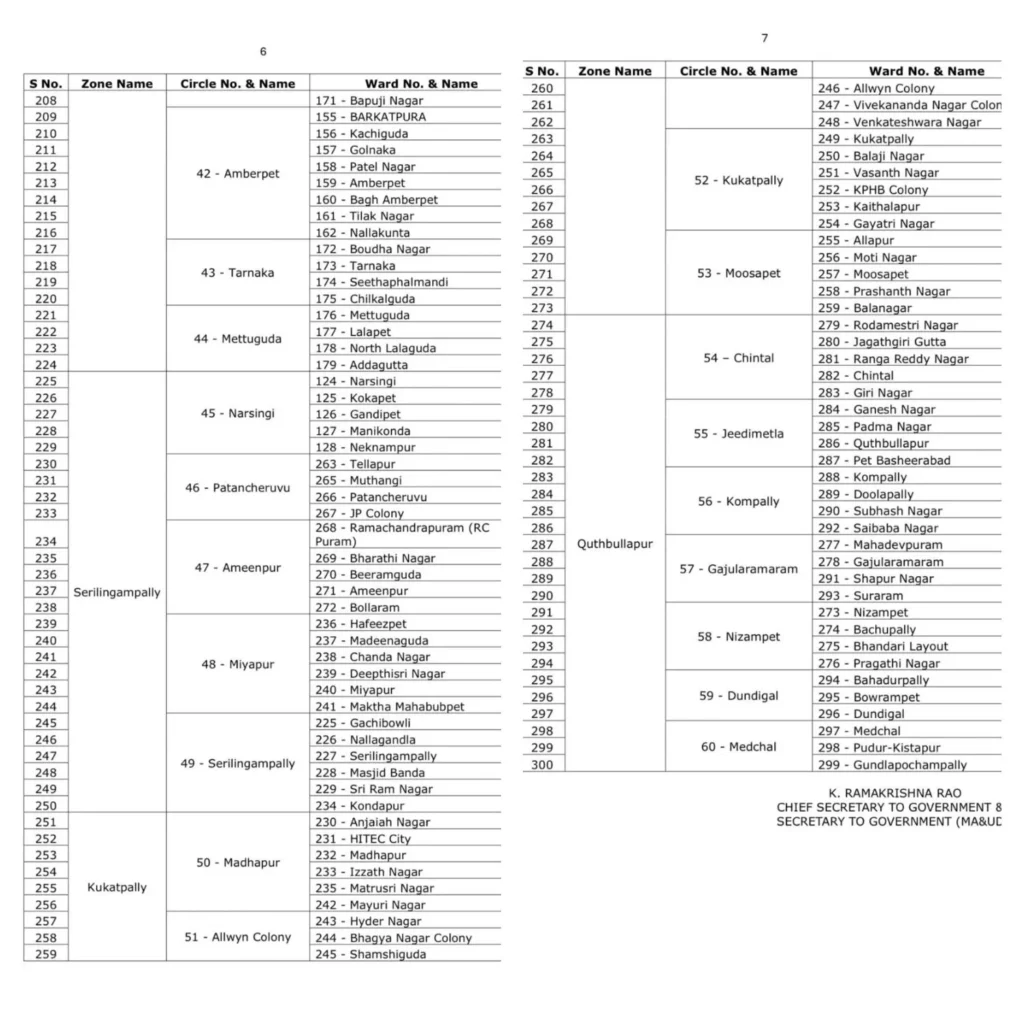
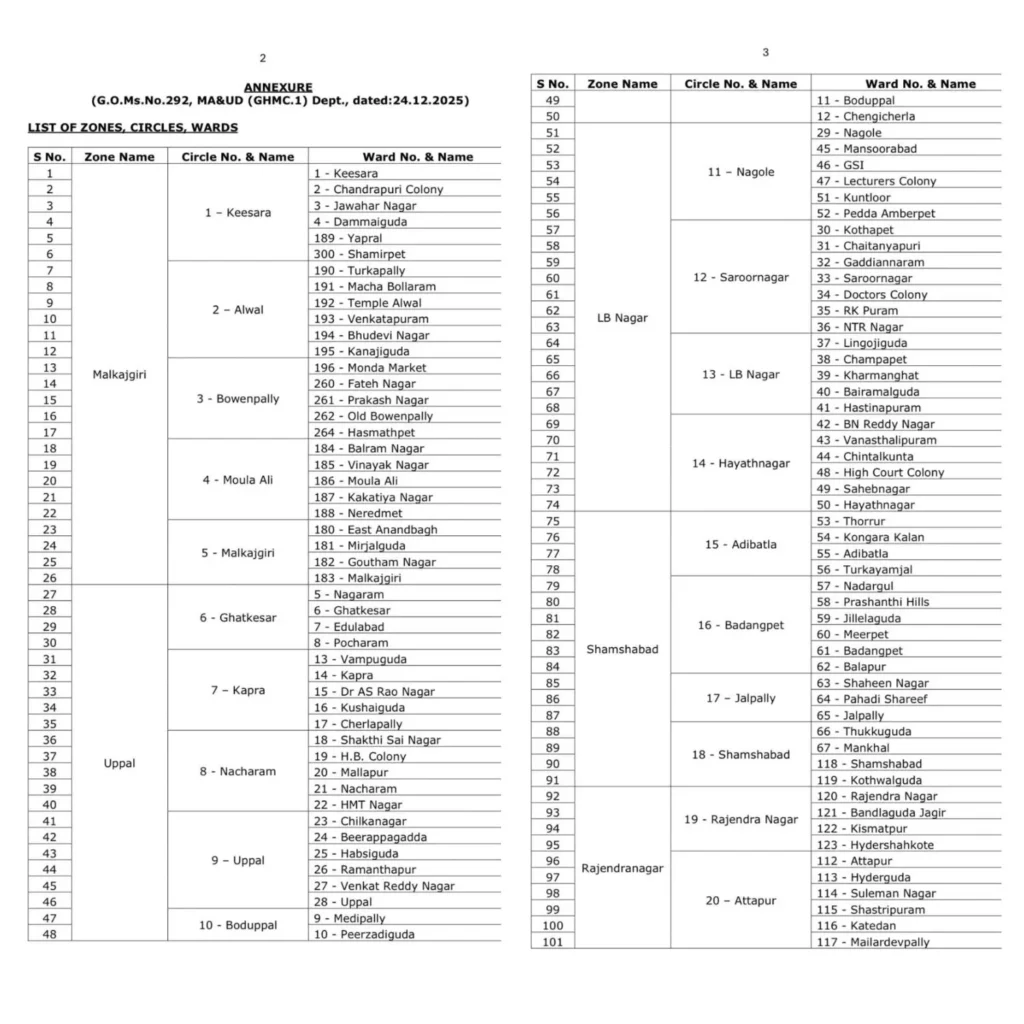
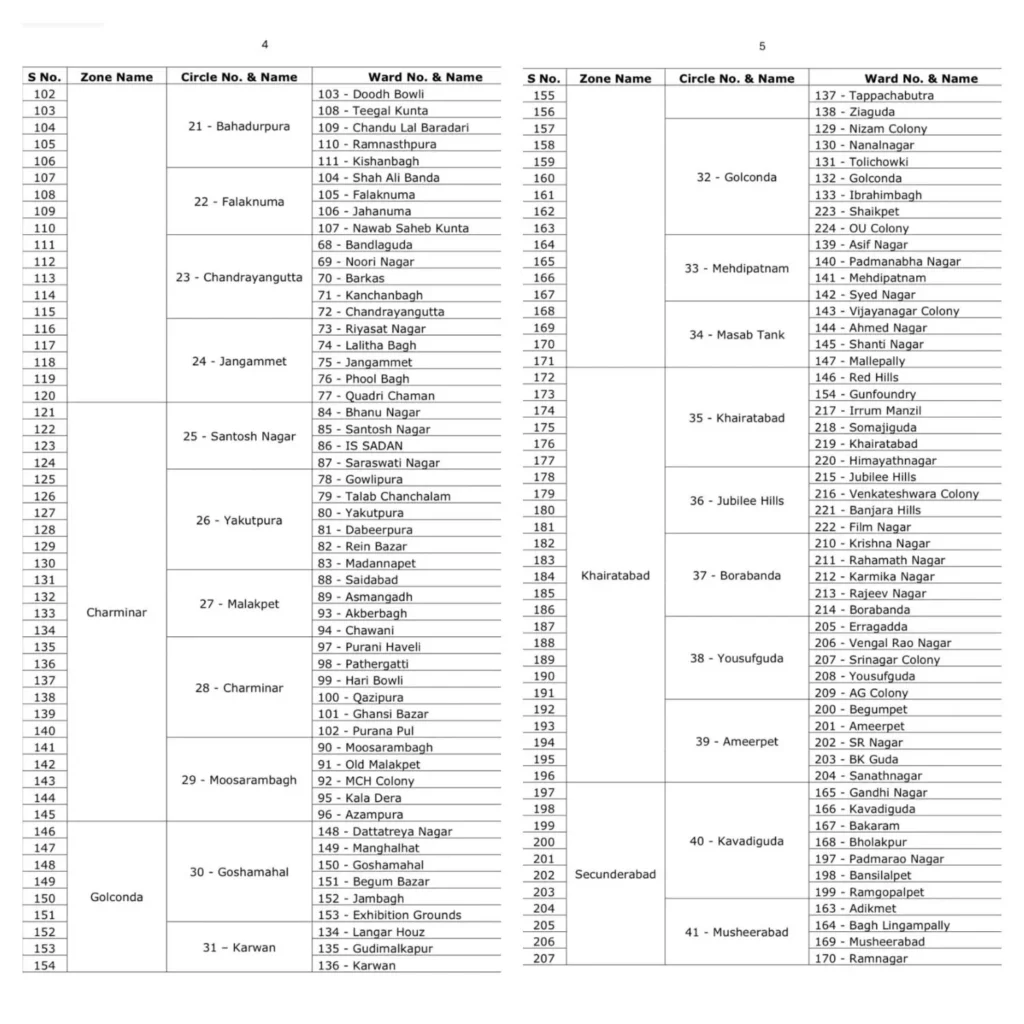
Simultaneously, the government released G.O. Ms. No. 292, outlining the newly restructured zones, circles, and divisions under the GHMC framework.

New Governance Architecture for the City

Under the revised administrative framework, the Greater Hyderabad Municipal Corporation (GHMC) will now operate through 12 zones and 60 circles, replacing the earlier six-zone structure. The reorganisation is aimed at improving administrative efficiency, promoting decentralised decision-making, and enhancing the delivery of civic services across the city.

Previously, GHMC comprised six zones—LB Nagar, Charminar, Serilingampally, Khairatabad, Kukatpally, and Secunderabad. As part of the restructuring, six new zones have been added: Malkajgiri, Uppal, Shamshabad, Rajendranagar, Golconda, and Quthbullapur, expanding the governance framework to better manage the city’s growing metropolitan footprint.

Each zone will comprise a minimum of four and a maximum of seven circles, depending on population and geographical spread.

Special Chief Secretary Post Created

In a significant administrative development, the Telangana government has created a new post of Special Chief Secretary, Metropolitan Area and Urban Development (within HMDA limits) to oversee the developmental needs of Hyderabad and the broader metropolitan region.

Senior IAS officer Jayesh Ranjan has been appointed to the newly created position. The role is expected to provide focused leadership and ensure coordinated planning for urban infrastructure, growth management, and overall metropolitan development within the HMDA jurisdiction.

Zonal Commissioners Appointed

Following the completion of the reorganisation, the Telangana government has appointed IAS officers as Zonal Commissioners for the newly created zones, ensuring that the restructured administrative units become operational without delay.

Zonal Commissioners Appointed

The Telangana government has appointed IAS officers as Zonal Commissioners for all 12 GHMC zones to ensure a smooth transition following the administrative reorganisation.

The newly appointed Zonal Commissioners are:

  • Bhorkhade Hemant Sahadeorao – Serilingampally
  • Apurv Chauhan – Kukatpally
  • Sandeep Kumar Jha – Quthbullapur
  • S. Srinivas Reddy – Charminar
  • G. Mukunda Reddy – Golconda
  • Priyanka Ala – Khairatabad
  • Anuraag Jayanti – Rajendranagar
  • N. Ravi Kiran – Secunderabad
  • K. Chandrakala – Shamshabad
  • Hemanta Keshav Patil – LB Nagar
  • Sanchit Gangwar – Malkajgiri
  • Radhika Gupta – Uppal

Officials stated that the swift appointment of Zonal Commissioners would help maintain continuity in governance and ensure the new administrative units become fully functional without delay.

‘No Disruption to Civic Administration’

GHMC Commissioner R.V. Karnan said the newly appointed Zonal Commissioners would assume charge immediately. He assured that all necessary arrangements had been made to ensure civic administration and essential public services continue uninterrupted during the transition.

Public Objections Examined

Before finalising the reorganisation, GHMC invited objections and suggestions from the public for nearly two weeks. After reviewing the representations received, authorities revised the boundaries and names of several divisions to address concerns raised by residents and other stakeholders.

Scale of the Reorganisation

  • Divisions renamed: 30
  • Divisions with boundary changes: 104

GHMC’s current administrative spread now covers:

  • Districts (fully/partially): 5
  • Mandals: 47
  • Villages: 311
  • Parliamentary constituencies: 6
  • Assembly constituencies: 28

“The comprehensive overhaul of GHMC’s administrative structure, along with the creation of a dedicated metropolitan-level leadership post, is expected to strengthen urban governance and support Hyderabad’s rapid growth in the coming years,” Commissioner Karnan said.