
17 Hyderabad Students Build Payload For Upcoming ISRO Launch
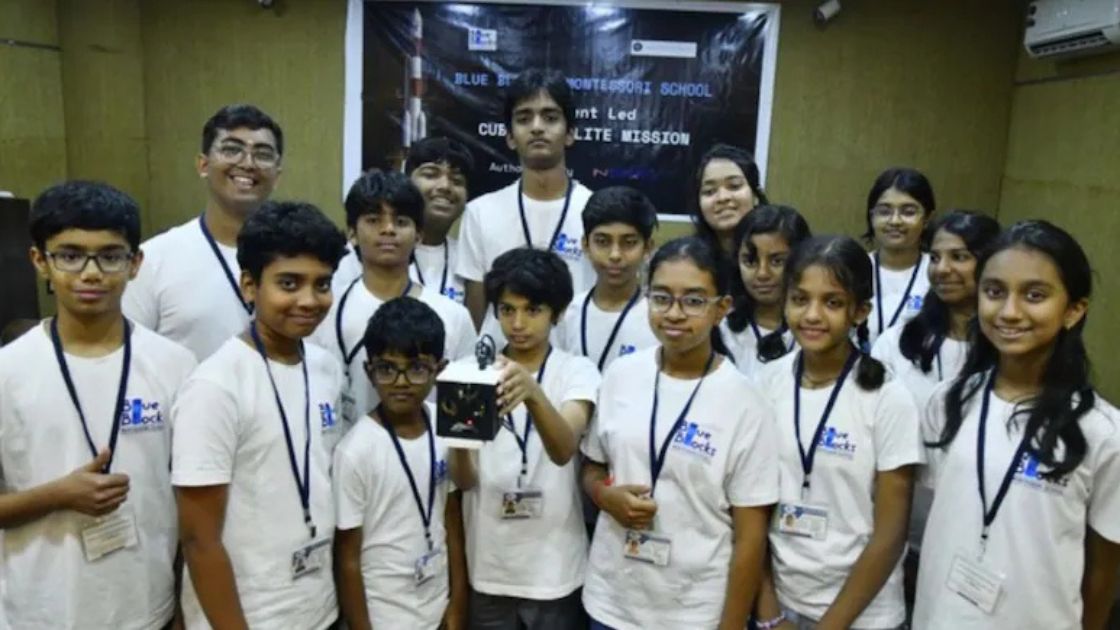
17 Hyderabad Students Build Payload for Upcoming ISRO Launch
The students of Blue Blocks Montessori School have named their payload Project SBB-1 (Satellite Blue Blocks-1), which has now received official clearance from ISRO for launch aboard the PSLV-C62 mission.
Hyderabad: A team of 17 students aged between 12 and 15 from Hyderabad has achieved a remarkable milestone by designing and building a flight-ready CubeSat payload, scheduled for launch aboard an ISRO mission on January 12 from the Satish Dhawan Space Centre (SDSC-SHAR), Sriharikota.
The students of Blue Blocks Montessori School have named their payload Project SBB-1 (Satellite Blue Blocks-1). The project has received official clearance from ISRO and will fly on the PSLV-C62 mission.
Setting their work apart from conventional school-level STEM projects, the students independently designed, assembled, and programmed the CubeSat payload. They used commercial off-the-shelf sensors, soldered electronic components, and developed firmware capable of transmitting real-time telemetry. While experts from Take Me 2 Space offered mentorship and technical guidance, the entire engineering effort—from hardware integration to coding—was carried out by the students themselves..
“Debugging the code when the sensors failed to communicate was the most challenging part. We didn’t want to just witness a launch—we wanted our work to fly on the rocket,” said one of the students.
The project was developed at the Blue Blocks Micro Research Institute using a learning framework known as ‘Structural Autonomy,’ which promotes independent problem-solving with minimal adult supervision. Emphasising the achievement, co-founder Pavan Goyal said, “They are not engineers of the future; they are flight-ready engineers today.”
The Blue Blocks initiative has earned international recognition, with the Nobel Peace Center in Oslo inviting co-founder Pavan Goyal to present the programme’s methodology. In addition, the students are set to deliver a technical review at the AMI Conference in Mexico, showcasing their work on a global stage.
About the PSLV-C62 Mission
The PSLV-C62 mission will carry the EOS-N1 Earth observation satellite, along with 15 co-passenger satellites from India and international partners. The mission will also feature a technology demonstration of the Kestrel Initial Technology Demonstrator (KID), a compact prototype re-entry vehicle developed by a Spanish startup.
ISRO’s Polar Satellite Launch Vehicle (PSLV) is regarded as the organisation’s most reliable launch system, having completed 63 successful missions. Its legacy includes landmark launches such as Chandrayaan-1, the Mars Orbiter Mission, Aditya-L1, and Astrosat, and it holds a global record for deploying 104 satellites in a single mission in 2017.