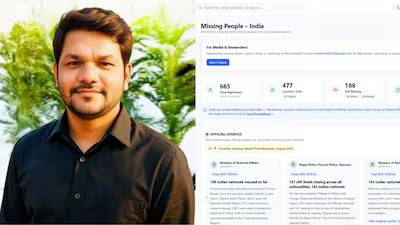
Hyderabad: In a remarkable example of technology serving humanity, Hyderabad-based software expert Arfath Mohammad has developed an AI-assisted platform, ReuniteIndia.com, to help families trace missing loved ones. Following the devastating Nepal floods in February 2026, the website has listed 665 individuals reported missing, safe or located, offering hope to families searching for information about their relatives.
From a Personal Experience to a Humanitarian Mission
The idea behind Reunite India originated from a distressing incident involving one of Mohammad’s close friends. The family had struggled to find their father, who was living with dementia and had wandered away from home. Witnessing their difficulties inspired Mohammad to create a digital platform that could help people locate missing family members.
Years later, the website is helping families affected by the Nepal floods by bringing together scattered information from multiple sources into one accessible platform.
Mohammad, a senior solutions architect and programming language expert, designed and developed the website himself.
AI Technology Helps Track Missing Persons
ReuniteIndia.com uses an AI-assisted system to collect and organise information from official sources, including India’s Ministry of External Affairs (MEA), Nepal Police and Nepal’s National Disaster Risk Reduction and Management Authority (NDRRMA).
According to the reported figures, the platform has listed 665 individuals, with approximately 477 identified as located or safe through the information gathered. Families can also submit missing-person cases directly through the website.
To maintain accuracy, Mohammad personally verifies every entry before publishing it. The platform also analyses updates from disaster management authorities and relevant social media posts, helping families access information that might otherwise remain scattered across different sources and languages.
The website can also help users identify nearby hospitals and police stations based on a missing person’s last-known location. It provides guidance to people who need assistance filing a missing-person report.
QR Codes Bring Real-Time Updates to Missing-Person Posters
One of the platform’s key features is its QR-code system, which helps families access updated information about missing individuals.
Traditional missing-person posters can quickly become outdated when new information becomes available. Reunite India’s QR-linked posters allow people to scan a code and view the latest available updates online, even if the poster was printed weeks earlier.
This feature makes it easier for people sharing or viewing missing-person information to check for developments without needing a new poster every time a person’s status changes.
Safety Profiles for Children, Senior Citizens and Vulnerable People
Beyond disaster response, Reunite India offers a safety-profile feature designed for people who may be at greater risk of becoming separated from their families.
Families can create a safety profile for children, senior citizens, people living with dementia and persons with disabilities. The website then generates a QR code that can be printed on a safety bracelet, wallet card or identification tag.
If the person gets lost, someone who finds them can scan the code to access the available safety information and help reconnect them with their family.
A Platform for Emergencies Beyond Floods
Mohammad says Reunite India was designed to support a wide range of missing-person situations, rather than being limited to a single disaster.
From children who wander away from home to senior citizens with dementia and individuals missing during floods or other emergencies, the platform aims to provide families with a central place to share information and search for updates.
The website also has the capability to track missing or stolen vehicles, potentially extending its usefulness beyond personal safety and disaster relief.
Hyderabad Techie Plans QR-Linked Safety Products
As the platform develops, Mohammad plans to introduce physical products connected to its digital safety features. Trial offerings include QR-linked safety bracelets, wallet identification cards and iron-on clothing labels.
These products are intended to make safety information more accessible when vulnerable individuals are away from home. The QR-linked information can be updated online without having to replace the physical item every time details change.
Mohammad also hopes to collaborate with state and central government agencies to expand the platform’s reach and explore how the technology could support missing-person searches and emergency response efforts.
Technology with a Human Purpose
Reunite India’s journey demonstrates how a personal experience can inspire a solution with wider social impact. By combining AI-assisted information gathering, manual verification and QR-based identification, the Hyderabad-developed platform aims to help families navigate the uncertainty of missing-person cases.
As natural disasters and other emergencies separate families, accessible digital tools like Reunite India could offer an additional way to share verified information and support efforts to reunite loved ones.